Read that again.
Not a screen.
Not a toy.
A steering wheel.
And you touch it…
before you even fully become you in the morning.
You don’t just “use” your phone.
Your phone uses tiny moments of you.
And stitches them into a life.
Every tap is a vote.
For the brain you’ll have.
For the focus you’ll keep.
For the sleep you’ll protect.
For the money you’ll grow.
For the future you’ll land in.
This isn’t a scary story.
It’s a power story.
Because the same truth that traps people…
also frees them.
Tiny choices feel harmless.
That’s the trick.
One more scroll.
One more notification.
One more late-night “just checking.”
One more “I’ll do it tomorrow.”
But your brain doesn’t count in “ones.”
It counts in reps.
Like push-ups.
Like practicing piano.
Like learning a secret spell.
And the wild part?
Tech is now mixed with AI.
So your tiny choices aren’t just habits.
They’re training data.
For you.
You are literally teaching your devices:
“Here’s what steals me.”
“Here’s what calms me.”
“Here’s what I crave.”
“Here’s what I ignore.”
“Here’s what makes me buy.”
So yes.
Your phone is a steering wheel.
But here’s the good news.
A steering wheel is not a prison.
You can grip it.
You can turn it.
You can aim it.
And you don’t need a “digital detox.”
You don’t need to throw your phone in a lake.
You don’t need to become a monk.
You need micro-moves.
Tiny swaps.
So small you almost laugh.
And in seven days…
you’ll feel the difference in your chest.
In your eyes.
In your calendar.
In your bank app.
In your mood.
Ready to see the two futures you’re building?
Right now?
With your thumb?
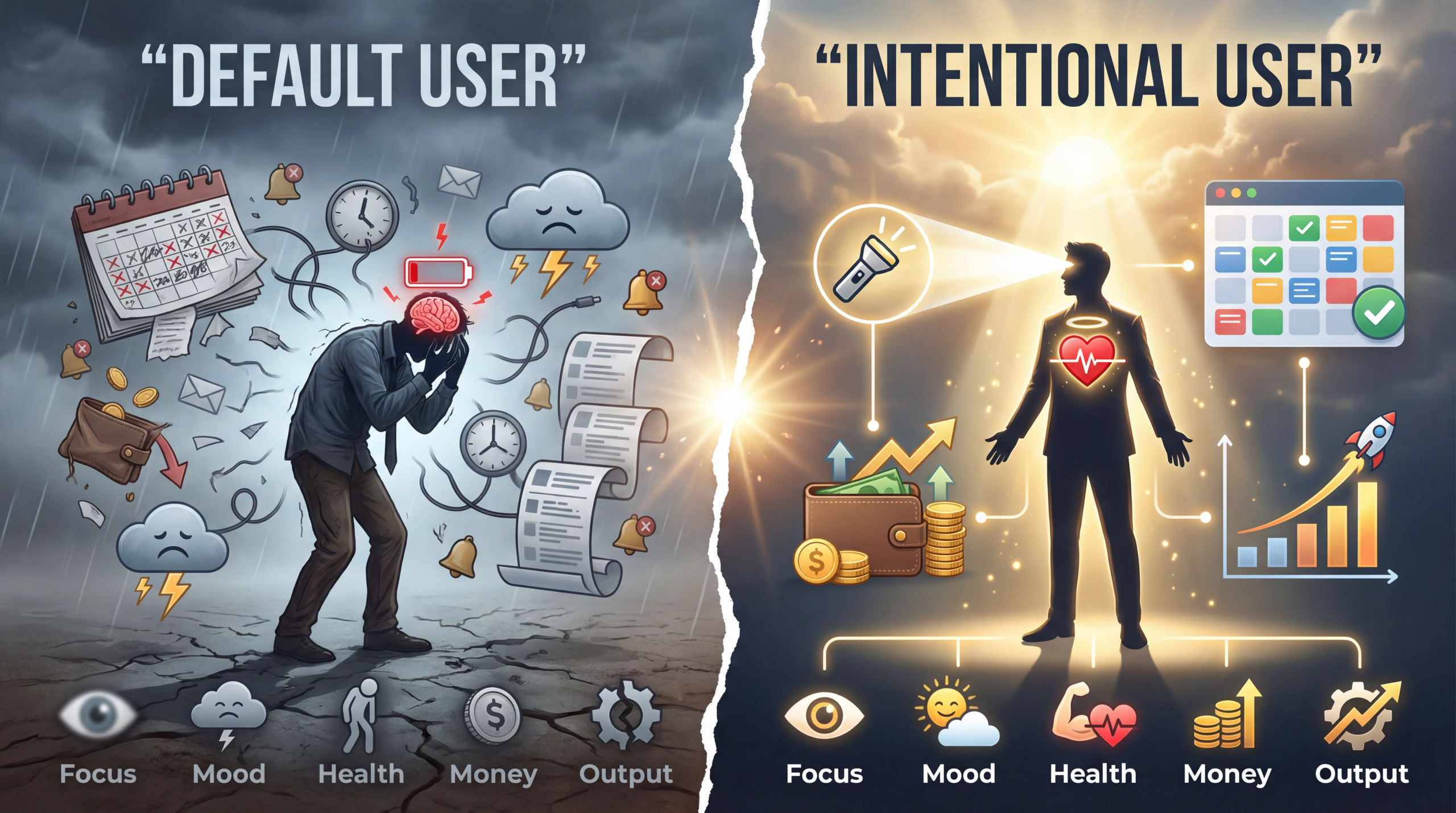
HERO IMAGE (Stop scrolling. This is the whole story.)
Caption: Two futures. One thumb.
The Invisible AI Tug-of-War in Your Pocket
Your phone is not “neutral.”
It’s not just a rectangle.
It’s a tiny casino.
A tiny TV studio.
A tiny mall.
A tiny gossip circle.
A tiny teacher.
A tiny boss.
And behind it?
A quiet tug-of-war.
On one side: You.
Your goals.
Your dreams.
Your peace.
On the other side: Attention magnets.
Built to pull.
Built to stick.
Built to win your eyes.
Here’s the simple, kid-level version.
Imagine your attention is a flashlight.
Wherever it points… your life grows.
Now imagine a million little hands.
All trying to grab that flashlight.
To point it at their stuff.
That’s the attention economy.
It’s not evil.
It’s just hungry.
Apps get paid when you stay.
When you click.
When you watch.
When you refresh.
When you argue.
When you buy.
So apps learn.
Fast.
They watch what you pause on.
They notice what makes your thumb hover.
They remember what makes you tap back.
That learning system?
That’s AI.
Not a robot walking around.
More like a super-fast pattern detective.
It’s like a dog that learns tricks.
Except the tricks are:
“Make them check again.”
“Make them feel behind.”
“Make them feel outraged.”
“Make them feel curious.”
“Make them feel not enough.”
“Make them feel like buying fixes it.”
And it works because your brain is ancient.
Your brain loves:
novelty, drama, social approval, quick rewards.
So the attention magnet tosses you tiny treats.
A like.
A message.
A new video.
A “breaking” headline.
A discount.
A notification bubble.
And your brain goes:
“Ooh. Snack.”
Now here’s the part people miss.
This tug-of-war isn’t just about time.
It’s about identity.
Because what you look at all day…
becomes what your brain thinks matters.
If you feed your brain chaos,
your brain starts living like chaos is normal.
If you feed your brain quick hits,
deep work starts feeling “boring.”
If you feed your brain comparison,
your real life starts feeling “small.”
If you feed your brain fear,
peace starts feeling “unsafe.”
That’s rewiring.
Not like a sci-fi chip.
Like a trail in the woods.
Walk the same path every day…
and the grass stops growing there.
Your brain is the woods.
Your daily tech choices are your footsteps.
So when someone says,
“I can’t focus anymore,”
I don’t hear a character flaw.
I hear a flashlight being yanked around.
And when someone says,
“I’m always tired,”
I don’t just hear “sleep.”
I hear:
late-night blue light,
late-night drama,
late-night dopamine,
late-night worry loops.
And when someone says,
“I’m broke,”
I don’t just hear “money.”
I hear:
impulse buys,
subscription leaks,
ads engineered to punch your weak spots,
and a calendar full of wasted hours.
But again: power story.
Because you don’t need to defeat “all AI.”
You need to stop playing on default settings.
Default is not your friend.
Default is what benefits the system.
Intentional is what benefits you.
So let’s talk about micro-choices.
The tiny steering turns.
The ones that feel silly.
Until they change your life.
Micro-Choices That Quietly Upgrade Your Brain
Your brain is a battery.
Not a machine.
A machine can grind forever.
A battery drains.
Attention drains it fastest.
Every time you switch tasks,
your brain pays a “switch fee.”
Check phone.
Back to work.
Check again.
Back again.
That’s not multitasking.
That’s attention bleeding.
And your brain hates bleeding.
So it asks for comfort.
Comfort looks like:
scrolling.
snacking.
shopping.
avoiding.
This is why tiny tech habits feel “small.”
But create big outcomes.
Because tiny habits decide:
Do you spend your battery on building?
Or on buzzing?
Now let’s talk dopamine.
But not the scary way.
Dopamine is like your brain’s:
“OOH, THIS MATTERS” sticker.
It helps you chase goals.
It helps you learn.
It helps you repeat good things.
But dopamine gets confused easily.
If you train dopamine on quick rewards,
slow rewards feel pointless.
That’s the doomscroll trap.
One video.
Tiny hit.
Next video.
Tiny hit.
Next video.
Your brain starts living on crumbs.
And real life feels like stale bread.
So what upgrades your brain?
Not willpower.
Design.
You don’t “fight” a magnet.
You change where the metal is.
Here are micro-choices that act like brain upgrades.
- Notifications: from “interrupt me” to “invite me.”
Most people live with phone screams.
Every app is allowed to shout.
That’s like trying to read a book in a room full of megaphones.
Turn off everything that isn’t human.
Let people reach you.
Not platforms. - Home screen: make it boring on purpose.
Your home screen is a snack drawer.
If it’s full of candy apps,
you’ll eat candy.
Put the fun stuff in a folder.
Put the useful stuff up front.
Make distraction take two extra steps.
Two steps is huge. - One “focus ritual” before you touch apps.
Before social apps, do one tiny “I’m in charge” move.
One breath.
One sip of water.
One note: “What do I want today?”
This breaks autopilot.
Autopilot is where the tug-of-war wins. - Night mode: treat sleep like a protected vault.
Your phone at night is a vampire.
It doesn’t drink blood.
It drinks tomorrow morning.
Put it away 30 minutes before sleep.
Not forever.
Just a tiny boundary.
Watch your mood upgrade. - AI used as a helper, not a hypnotist.
AI can be a jetpack.
Or a pacifier.
If you use AI to avoid thinking, you shrink.
If you use AI to speed up boring parts, you grow.
Ask AI to outline.
To summarize.
To brainstorm.
Then you choose. - Stop “information grazing.” Start “information meals.”
Grazing = random bites all day.
Meals = you choose a time, a topic, a purpose.
Your brain loves meals.
It relaxes.
It learns.
It remembers.
Now, I promised shocking-but-simple facts.
Here are six.
Fact #1: Your brain learns what you repeat.
Not what you “want.”
Repeat scroll.
Get scroll brain.
Fact #2: Every notification trains you to expect interruption.
Expect interruption.
Lose deep focus.
Fact #3: Your mood is not only “chemicals.”
It’s also inputs.
Your phone is an input firehose.
Fact #4: The first 20 minutes of your day set the lens.
Start with chaos.
Your day feels like chaos.
Fact #5: “Free” apps often cost attention.
Attention is time.
Time is life.
Fact #6: Tiny friction changes behavior fast.
One extra step can break a habit loop.
So no.
You are not broken.
Your phone is just perfectly optimized.
For someone else’s goal.
Now let’s flip it.
Let’s talk about money and time.
Because this is where people gasp.
Infographic 1 (Fastest “Oh wow” cheat sheet)
Caption: Seven tiny clicks. Seven big life upgrades.
The Tiny Tech Habits That Grow Money and Time
Most people think money is about big moves.
A new job.
A side hustle.
A lucky break.
Those matter.
But they sit on top of a hidden layer.
The hidden layer is:
tiny leaks.
And tiny multipliers.
Your tech habits decide both.
The leaks
Leaks are sneaky.
They don’t feel like spending.
They feel like “just this once.”
But your phone is basically a leak machine.
One-click buying.
Auto-renew subscriptions.
Ads that know your weak moments.
“Limited time” panic.
Late-night impulse taps.
And there’s a time leak too.
Five minutes here.
Ten minutes there.
Twenty minutes before bed.
It adds up like water dripping in a bucket.
Except the bucket is your life.
The multipliers
Now the fun part.
AI tools can be time multipliers.
A multiplier is not magic.
It’s leverage.
Like using a shovel instead of your hands.
If you do this right,
you don’t just “save time.”
You create space to learn.
To build.
To rest.
To earn.
So here are simple workflows anyone can copy.
No jargon.
No fancy setup.
Workflow 1: “Two-Minute Brain Dump → AI Organizes”
You feel overwhelmed.
Your brain has 37 tabs open.
Do this:
- Open notes.
- Dump everything in messy bullets.
- Paste into an AI tool.
- Ask: “Turn this into a simple plan with next steps.”
Boom.
Your brain stops buzzing.
You stop avoiding.
You didn’t “get lazy.”
You got clarity fast.
Workflow 2: “Email Monster → AI Makes It Friendly”
You need to write something scary.
Do this:
- Write the ugliest version first.
No grammar.
Just truth. - Ask AI: “Make this polite, clear, and short.”
Now you send the email.
Instead of procrastinating for three days.
That’s time you get back.
Workflow 3: “Learning Ladder”
Most people “learn” by saving videos.
They never watch them.
Do this:
- Pick ONE skill.
Like: Excel, writing, sales, coding, speaking. - Every day, spend 10 minutes.
Not 2 hours.
Ten. - Ask AI: “Give me a 10-minute lesson and one tiny practice.”
That’s a ladder.
Step by step.
Day 1 you feel dumb.
Day 30 you feel dangerous.
Day 365 you become the person people ask for help.
Workflow 4: “Money Autopilot, But For You”
Money grows when decisions are smaller.
Do this:
- Set one weekly money check.
Same day, same time. - Use a budgeting app or spreadsheet.
Not to judge yourself.
To see truth. - Cancel one subscription you forgot.
Every week.
One.
That’s not extreme.
That’s adult magic.
Now here’s the twist.
The biggest money gain isn’t saving $9.99.
It’s what happens when you stop being tired.
Tired people spend.
Tired people order delivery.
Tired people buy comfort.
Tired people avoid learning.
Tired people stay in jobs they hate.
So your “tech habits” are also “energy habits.”
Energy becomes action.
Action becomes income.
This is why the steering wheel matters.
It’s not moral.
It’s mechanical.
If you want more time,
stop bleeding attention.
If you want more money,
stop paying the “default tax.”
Default tax = subscriptions + impulse + distraction.
Now let’s make this emotional and real.
Three mini-stories.
No superheroes.
Just normal humans.
With tiny tweaks.
Infographic 2 (The punch-in-the-face split screen)
Caption: Same phone. Different destiny.
Real Mini-Stories: Small Tech Tweaks, Massive Wins
1) The student: “I thought I had no discipline.”
Meet Maya.
She’s smart.
She’s exhausted.
She sits down to study.
And her phone is like:
“Hey.”
“Hey.”
“Hey.”
“Hey.”
She thinks she’s weak.
She thinks she’s lazy.
But she’s just in a room full of megaphones.
So she does one “silly” tweak.
She turns off every notification.
Except calls from family.
And one friend.
That’s it.
Next day she studies.
And something weird happens.
She doesn’t get pulled.
She feels calmer.
She reads two pages.
Then five.
Then ten.
She’s shocked.
Like: “Wait. I can do this?”
Then she adds one more tweak.
Phone charges across the room at night.
Not on the bed.
She sleeps deeper.
Wakes up less angry.
Stops “panic scrolling” in the morning.
Her grades don’t explode instantly.
But her brain stops feeling like it’s on fire.
She says the weirdest thing:
“I feel like myself again.”
That’s the win.
Not perfect grades.
A rescued brain.
2) The working adult: “My day was eaten alive.”
Meet Jordan.
Good job.
Big to-do list.
No time.
Every day felt like a chase scene.
Slack.
Email.
Calendar.
Messages.
More messages.
He was busy.
But not moving.
So he tries a micro-rule:
No inbox until he’s done one ‘building block.’
One block = 25 minutes.
One task that matters.
He sets a timer.
He hides the inbox apps in a folder.
The first day is painful.
His brain screams:
“Check! Check! Check!”
But he doesn’t.
He finishes one block.
And gets a tiny hit of pride.
That pride is a different dopamine.
A deeper one.
The kind that builds identity.
In two weeks, he notices something scary.
He used to spend his best brain hours
feeding other people’s urgency.
Now he uses them
building his own value.
He starts finishing work earlier.
He goes on walks.
He laughs more.
He applies for a better role.
Not because he became a productivity robot.
Because he stopped being “available to be eaten.”
3) The small business owner: “AI didn’t replace me. It rescued me.”
Meet Lila.
She runs a tiny online shop.
Everything was manual.
Everything was slow.
She was drowning in:
product descriptions, replies, posts, invoices.
So she makes a deal with herself.
AI can do the boring parts.
She keeps the taste.
She uses AI to draft descriptions.
Then she edits them with her voice.
She uses AI to answer common questions.
Then she adds a human line at the end.
She uses AI to plan weekly content.
Then she films two short videos herself.
The result?
She gets hours back.
She uses that time to improve photos.
To negotiate with suppliers.
To learn pricing.
To rest.
Her sales grow.
But more importantly…
She stops feeling like her business is eating her alive.
She says:
“I didn’t need more hustle. I needed leverage.”
That’s the point.
Tiny tech choices don’t just change tasks.
They change how life feels inside your body.
Now you’re ready for the fun part.
A reset.
Seven days.
Tiny actions.
Not strict.
Not cringe.
Just doable.
The 7-Day Tech Reset Anyone Can Start Today
You’re not “starting over.”
You’re steering.
This is not a cleanse.
This is not punishment.
This is:
“I’m building a brain I like living in.”
Day 1: Silence the megaphones
Action: Turn off notifications for everything except humans.
Keep: calls, texts, and maybe one important work tool.
Tiny but huge.
You will feel calmer within hours.
Bonus: Put your phone on silent by default.
Let you choose.
Day 2: Make distraction take two steps
Action: Clean your home screen.
Only keep tools you use on purpose:
maps, camera, messages, calendar, notes.
Put social and scrolling apps in a folder.
Name it something honest.
Like: “Time Swallow.”
Two steps breaks autopilot.
Day 3: Build a “morning shield”
Action: First 20 minutes of the day = no feeds.
No news.
No comments.
No doom.
Do one of these instead:
water, stretch, shower, sunlight, a short walk.
Your day will feel less haunted.
Day 4: Set one “deep focus island”
Action: One 25-minute block with phone out of reach.
Not forever.
Just one island.
Pick one task that matters.
Timer on.
Phone away.
When you finish, celebrate a little.
Your brain needs to tag it as “good.”
Day 5: AI as a shovel, not a stroller
Action: Use AI once today to remove friction.
Examples:
- “Turn my messy notes into a plan.”
- “Draft a polite email.”
- “Give me 10 ideas for a project.”
- “Explain this like I’m 10.”
Then you decide.
You lead.
AI assists.
Day 6: Plug the money leaks
Action: Cancel one subscription.
Just one.
Then set a weekly 10-minute money check.
Same time every week.
You’re not trying to be perfect.
You’re trying to be awake.
Day 7: Lock in sleep like it’s sacred
Action: Phone charges outside the bed area.
Or at least out of arm’s reach.
Add one tiny sleep trigger:
dim lights, night mode, or a “shutdown” playlist.
Your brain will feel less spiky tomorrow.
That’s it.
Seven days.
Seven steering turns.
And here’s what’s wild.
You won’t just “use your phone less.”
You’ll feel like time got wider.
Because attention is what makes time feel real.
When your attention is chopped up,
your day feels like static.
When your attention is whole,
your day feels like a story.
Now let’s handle the questions people always ask.
The anxious ones.
The practical ones.
The “but what about…” ones.
FAQ (Calm answers for a loud world)
“Is AI making us lazy?”
AI can make you lazy.
Or it can make you powerful.
If AI replaces your thinking,
your thinking muscle shrinks.
If AI replaces boring steps,
your thinking muscle grows.
Use AI like a bicycle.
It helps you go farther.
But you still steer.
“How do I stop doomscrolling?”
Don’t start with motivation.
Start with friction.
Do one of these:
- Move the app to the last page.
- Log out.
- Turn the screen grayscale at night.
- Set a timer for 5 minutes.
- Replace the habit with a “tiny fill”: music, a short walk, a glass of water.
Doomscrolling is often a feeling problem.
Not a self-control problem.
Ask: “What am I trying not to feel?”
Then do one tiny kind thing for yourself.
“What if I need social media for work?”
Then make it a tool.
Not a home.
Do “office hours.”
Pick two short windows:
like 11:30 and 4:30.
Post.
Reply.
Leave.
Don’t live inside the feed.
Visit it.
And remove it from your home screen anyway.
Tools don’t belong in your snack drawer.
“Why do I feel anxious after being online?”
Because your brain thinks inputs are reality.
Online is loud.
Fast.
Emotional.
Perfect-looking.
Argument-shaped.
If you bathe in that,
your nervous system stays on alert.
Try this tiny rule:
After 10 minutes online,
touch the real world.
Look out a window.
Pet an animal.
Walk to the kitchen.
Breathe.
Remind your brain:
“I’m safe. I’m here.”
“Is screen time always bad?”
No.
Screen time is like food.
Quality matters.
A video call with a friend?
Nourishing.
Learning a skill?
Nourishing.
Doomscrolling at midnight?
Junk.
Ask: “Did this feed me… or eat me?”
“What’s the single fastest change?”
Notifications.
They are the leash.
Cut the leash,
and you get your brain back faster than you expect.
Infographic 3 (The compounding miracle)
Caption: The scariest part? It adds up quietly.
Conclusion: Do This One Life-Changing Tech Action Today
Do one thing.
Right now.
Turn off notifications for every app that isn’t a human.
That’s it.
Not tomorrow.
Not after you “finish this article.”
Now.
Because that one move does something magical.
It returns your attention flashlight to your hand.
And once you hold it again…
everything else gets easier.
Sleep gets easier.
Work gets easier.
Learning gets easier.
Money gets easier.
Life gets lighter.
Your phone is a steering wheel.
But you are the driver.
Shareable one-liner:
Small taps build big lives. Choose your next tap like it matters.