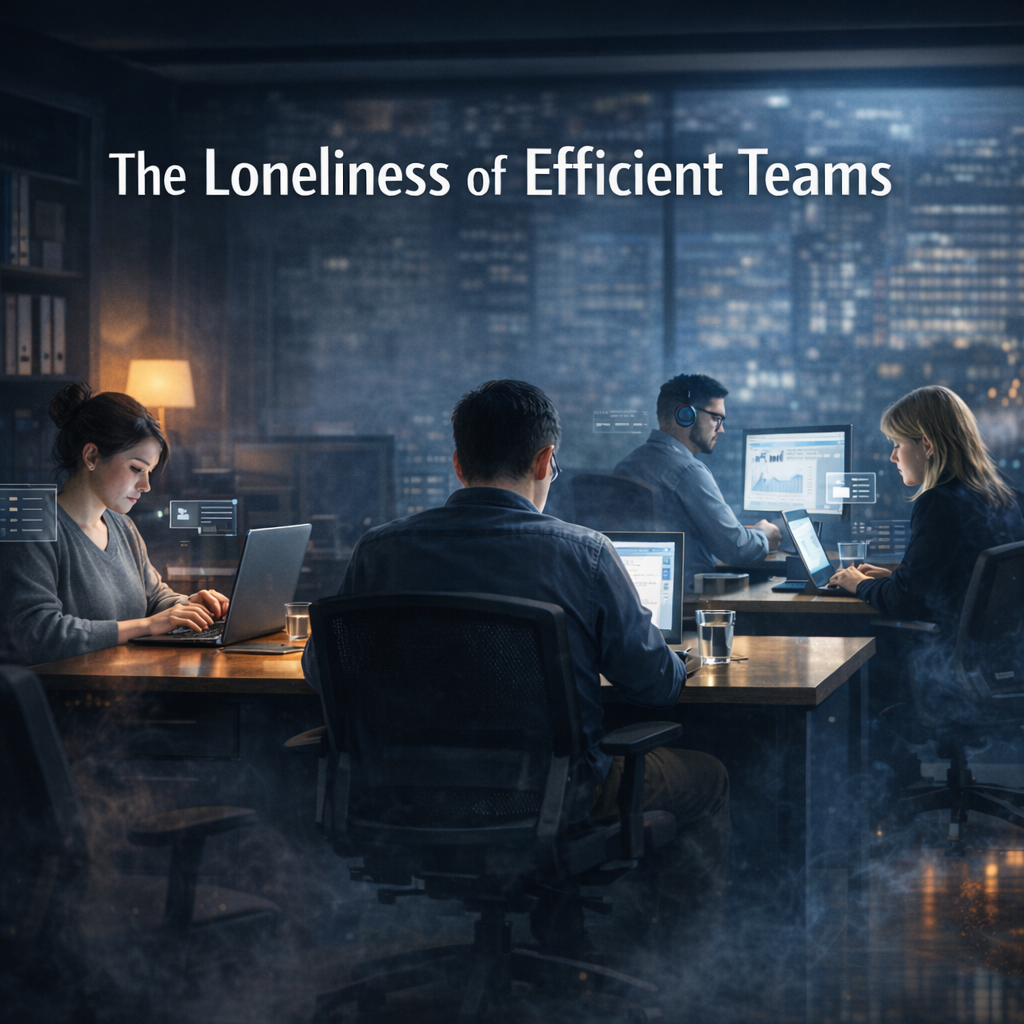
Every productivity dashboard shows the same triumph: tickets closed faster, response times halved, output per employee climbing steadily upward. The numbers say we’re winning. But walk through any office using AI assistance at scale, and you’ll notice something the metrics don’t capture—people have stopped asking each other for help.
This isn’t about AI replacing jobs. That conversation, exhausting as it is, misses something quieter and possibly more destabilizing: automation is removing the social scaffolding that held teams together. The casual question across desks, the coffee-machine brainstorm, the “got a minute?” that turned into collaborative problem-solving—all evaporating because asking an AI is faster, cleaner, and doesn’t risk looking incompetent.
We optimized for efficiency and got isolation as a side effect.
What Looks Like Productivity Gains
The story most organizations tell themselves goes like this: AI tools handle routine questions, freeing humans for “higher-value work.” Sales teams use AI to draft emails. Customer service agents get suggested responses in real-time. Engineers have coding assistants that autocomplete entire functions. Managers receive AI-generated summaries of team activity instead of walking the floor.
The measurable results are remarkable. A mid-size software company recently reported that developer productivity increased by 34% after deploying AI coding assistants. Support ticket resolution times dropped by 41% at a fintech startup using AI triage. These aren’t marginal improvements—they’re the kind of leaps that justify entire transformation roadmaps.
But here’s what the dashboard doesn’t show: the number of internal Slack messages between team members dropped by half in the same period. Not because people communicated more efficiently. Because they stopped needing to communicate at all.
When you can ask an AI for the answer to almost anything—from debugging code to drafting policy language to explaining last quarter’s numbers—the transaction cost of human interaction suddenly feels expensive. Why interrupt someone, wait for their response, possibly misunderstand their explanation, when you can get a clean answer from an assistant instantly?
The economic logic is flawless. The social consequence is invisible until it compounds.
What’s Actually Happening to Team Dynamics
Human collaboration has always involved massive amounts of inefficiency. Someone asks a question they could have figured out themselves. A junior employee interrupts a senior one for guidance. Two people spend twenty minutes working through a problem that one of them could have solved alone in ten.
That “waste” served a function we’re only recognizing in its absence: it was the immune system of organizational knowledge. Those interruptions were how junior people learned not just answers, but how to think about problems. The redundant conversations were how teams built shared mental models. The seemingly inefficient back-and-forth was how trust got established and maintained.
AI assistance short-circuits all of it. When a new team member can onboard by querying an AI trained on company documentation instead of bothering colleagues, they learn the explicit knowledge but miss the implicit culture. They know what to do but not why it matters, who cares about what, or how things really get decided when the process breaks down.
The pattern shows up most clearly in remote teams. A design agency in Berlin noticed that their junior designers stopped posting work-in-progress in team channels once they started using AI feedback tools. The work quality didn’t drop—the AI gave solid critique—but senior designers stopped seeing how juniors were thinking. When promotion time came, leadership realized they had no idea who was ready to step up because they’d stopped observing the learning process.
More concerning: the junior designers didn’t know each other. They’d all joined during the AI-assisted era and had never needed to ask peers for help. When the AI tools went down for a day due to API issues, productivity collapsed. Not because people couldn’t do the work, but because they had no habit of collaboration to fall back on.
The Hidden Cost No One’s Measuring
Organizations measure output, efficiency, cost per transaction, time-to-resolution. None of these metrics capture team cohesion, institutional knowledge transfer, or the strength of working relationships. Which means the degradation happens silently.
Consider what gets lost when a senior developer stops being interrupted:
They don’t know what the junior developers are struggling with, so they can’t anticipate training needs or systemic issues. Junior developers don’t learn the senior’s problem-solving heuristics—the intuitions that don’t fit in documentation. The codebase becomes more consistent (the AI enforces patterns) but less adaptable (no one’s learning to break rules intelligently). When the senior developer leaves, their expertise doesn’t live on in mentored successors.
Multiply this across every knowledge worker in every function, and you get organizations that appear to run smoothly but have become brittle. They’re highly optimized for the current state but unable to adapt because the informal learning networks have atrophied.
This has a particularly brutal effect on career development. Historically, much of workplace learning happened through observation and peripheral participation. You’d overhear the tense budget negotiation and learn stakeholder management. You’d watch a senior colleague navigate a client crisis and internalize their approach. You’d be pulled into a problem above your pay grade because someone needed an extra pair of hands and end up learning a new domain.
When everyone works in parallel with AI assistants, these learning opportunities evaporate. The junior marketer who uses AI to draft campaign copy never sits with the senior strategist understanding how brand voice gets crafted. The analyst who queries an AI for financial modeling never learns to think like the CFO by walking through the logic together.
Companies are discovering this the hard way during succession planning. The people they expected to promote aren’t ready, not because they lack skills but because they lack judgment—the tacit knowledge that used to transfer through working closely with experienced colleagues.
Who Benefits and Who Gets Left Behind
The efficiency gains from AI assistance are real, but they’re not distributed evenly. Experienced professionals get a powerful accelerant—they know what to ask for, can evaluate AI outputs critically, and have existing networks to fall back on when automation fails. They’re getting more done with less effort, and their value increases.
Mid-career professionals face a strange squeeze. They’re efficient enough that they don’t need much help, but not senior enough to be irreplaceable. The AI does much of what made them valuable—synthesizing information, drafting communications, executing established processes. Their path to seniority traditionally involved being pulled into higher-level problems by executives who needed support, but now those executives have AI assistance instead.
Early-career workers face the steepest cost. They’re entering organizations where the apprenticeship model has quietly collapsed. They can perform tasks competently with AI help but aren’t developing the judgment, relationships, or institutional knowledge that enable long-term career growth. They’re productive in the moment but not being groomed for leadership.
The asymmetry shows up starkly in the data. A recent analysis of promotion rates at companies with high AI adoption showed that time-to-promotion increased by an average of 14 months for employees who joined after AI tools were deployed, compared to those hired before. The newer employees performed well on standard metrics but lacked the visibility and relationship capital that drive advancement.
Meanwhile, the most senior leaders are often insulated from the problem. Their role involves more judgment and relationship management—work that’s AI-adjacent but not AI-replaceable—and they interact with a small circle of peers through channels that haven’t changed much. They see the productivity numbers and assume the organization is healthy.
The Second-Order Effects Starting to Surface
The long-term consequences of this shift won’t be obvious for years, but early signals are emerging. Companies are reporting an unexpected difficulty: they can’t find people for senior roles. Not because there aren’t qualified candidates in the market, but because their internal pipeline has gone dry. The efficient teams of AI-assisted workers haven’t been developing leaders.
Innovation patterns are changing too. Historically, many breakthrough ideas emerged from collision—someone working on problem A overhears someone else’s struggle with problem B and recognizes a connection. These accidental insights require proximity and communication. In teams where everyone works in parallel with AI assistance, the collision rate plummets.
One research lab found that their ideation sessions became noticeably less productive after researchers started using AI literature review tools. Individual researchers were better informed, but the shared context necessary for collaborative breakthroughs had disappeared. They knew different things but had no common foundation to build on.
There’s also an emerging mental health dimension. Work, for all its flaws, has historically provided social connection—a sense of being part of something, contributing to a shared effort. When work becomes a series of individual tasks mediated by AI, that social fabric tears. Employees report feeling disconnected, unsure whether their colleagues would even notice if they disappeared.
The resignation patterns are telling. Exit interviews at a consulting firm revealed that high performers were leaving not because of compensation or workload but because they “didn’t feel like part of a team anymore.” The work was efficient, the feedback was instant (from AI), but the human connection had evaporated.
What This Means for the Next Five Years
Organizations are beginning to recognize the problem, though few have coherent responses yet. Some are implementing “collaboration quotas”—requirements for cross-team projects or mentorship hours—but these feel forced and don’t replicate the organic knowledge transfer that happened naturally before.
The smarter companies are redesigning work to preserve human connection where it matters most. Instead of using AI to eliminate collaboration, they’re using it to eliminate the drudgery that prevented deeper collaboration. The AI handles the routine so that human interaction can focus on the complex, ambiguous, and novel—the work that actually requires multiple perspectives.
This means rethinking productivity metrics. If your dashboard only tracks individual output, you’re optimizing for isolation. Teams need to measure knowledge transfer, network density, and collaborative problem-solving alongside traditional efficiency metrics. The question isn’t just “how much did we produce?” but “how much did we learn?” and “how strong are our connections?”
There’s also a brutal selection effect coming. Organizations that figure this out will develop talent internally and maintain adaptive capacity. Those that don’t will become dependent on external hiring for any role requiring judgment, and will struggle to maintain culture and institutional knowledge across leadership transitions.
The worker experience will bifurcate. Some people will work in rich, collaborative environments where AI amplifies human connection. Others will work in isolated, transactional settings where AI mediates all interaction. The difference won’t be obvious from job descriptions or compensation, but it will determine career trajectories and quality of life.
The Uncomfortable Question
The core tension isn’t going away: genuine efficiency and organic collaboration often conflict. A perfectly efficient organization might be one where everyone works alone with AI assistance, never interrupted, maximally productive. A resilient, adaptive, innovative organization is necessarily inefficient—full of interruptions, redundant conversations, time spent building relationships that may never have clear ROI.
We’re not going back to the pre-AI era, nor should we. But we need to acknowledge what we’re trading. Every time we route a question to an AI instead of a colleague, we’re making a choice: immediate efficiency over relationship building. Often that’s the right choice. But if it’s always the right choice, we’re building organizations that are optimized for today’s problems and fragile against everything else.
The teams that thrive in the next decade won’t be the most efficient. They’ll be the ones that figured out how to preserve human connection in an age of automated assistance. They’ll have intentionally built in the “inefficiencies” that keep people linked—not despite the AI tools, but as a deliberate counterbalance to them.
Because it turns out that the inefficiency wasn’t waste. It was the thing holding us together. And we’re only noticing now that it’s gone.
Hero Image Generation Prompt:
Ultra-wide cinematic banner image (21:9 aspect ratio) showing a stunning, photorealistic scene: A vast corporate office floor at twilight, viewed from above at a dramatic angle. Hundreds of empty desks with glowing monitors stretch into the distance, but in the foreground, a single person sits working, surrounded by holographic AI assistant avatars that appear as translucent, ethereal figures standing behind empty chairs. The lighting is cinematic with deep blue hour light coming through floor-to-ceiling windows, creating long shadows. Golden accent lights from desk lamps create warm pools of light. The image has a melancholic, thought-provoking mood.
CRITICAL TEXT REQUIREMENT: The title “The Loneliness of Efficient Teams” must appear integrated into the scene – perhaps as subtle architectural text on a glass wall or elegantly overlaid in bold, modern sans-serif typography (white or light blue color) in the upper third of the image. The text must be perfectly spelled, highly readable, and feel like a natural part of the composition.
Style: High-end editorial photography, cinematic color grading, sharp focus, dramatic lighting, professional magazine quality. NO clichés, NO floating UI elements, NO logos, NO watermarks. Maximum resolution and detail.